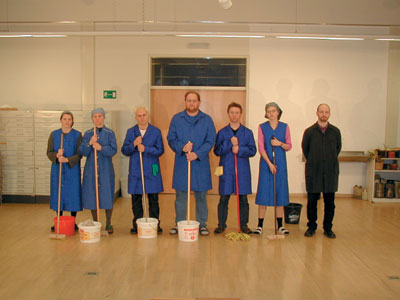
Sauber. Macher. Innen. Cleaners. Male. Female.
Video. ca. 2.30
min., oberösterreichisch mit englischen Untertiteln, 2001
Video,
ca. 2.30 min., original version with English subtitles, 2001
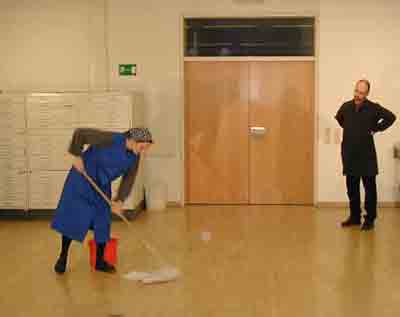
Änderungen in einem Aufwisch
"wos derf i denn putzn?"
* , fragt die Putzfrau (in blau) den Hausmeister (in schwarz).
"des
do", antwortet er und zeigt auf den blitzblanken Boden. Ein kurzer, wortkarger
Dialog entsteht. Sie
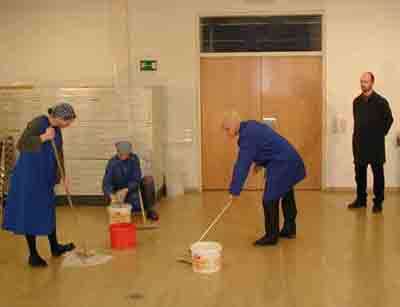
beginnt zu putzen. Nach und nach treffen fünf weitere Putzmänner
und -frauen ein, mit
denen exakt der gleiche Dialog geführt wird. Einziger Unterschied:
In der ersten Frage
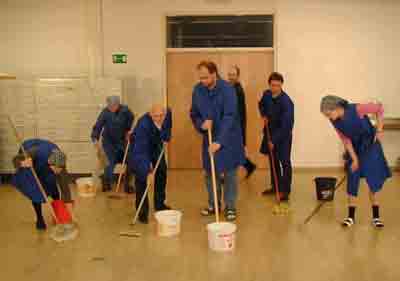
verändern sich jeweils die Modalverben. Der Raum füllt sich immer
mehr mit putzen dürfenden,
könnenden, mögenden, müssenden, sollenden, wollenden
Frauen und Männern,
die den ohnehin schon spiegelnden Boden schrubben. Grundsätzlich
liegt die Aufgabe von Modalverben darin, in Verbindung mit einem Infinitiv -
hier "putzen"
- ein anderes Sein und Geschehen zu modifizieren, also die Art und Weise, wie
und aus
welcher Motivation heraus etwas gemacht wird, näher zu bestimmen. So unterscheiden
sich zum Beispiel "putzen wollen" und "putzen müssen"
dadurch radikal, daß bei
letzterem zumindest eine zweite Instanz vorhanden sein muß, die zur Handlung
zwingt,
wohingegen "wollen" eine freie Entscheidung impliziert.
Daß
in diesem Video das Putzen kaum eine freiwillige Tätigkeit ist, macht nicht
nur der
Hausmeister als Auftraggeber und Kontrollorgan deutlich. Auch die teilnahmslosen
Gesichter des Reinigungspersonals, das seine Aufgabe beinahe schicksalshaft
ausübt,
führen die jeweils veränderten Modalverben ad absurdum. Ob sie wollen,
können,
dürfen oder sollen, letzten Endes verrichten sie die gleiche sinnlose Arbeit.
Herbert Stögers "SaubermacherInnen" sind ganz gewöhnliche
ArbeitnehmerInnen,
die, ohne die Sinnhaftigkeit ihrer Tätigkeit zu hinterfragen, brav mitspielen
im vor
Absurdität strotzenden Welttheater; und die veränderten Modalverben
dienen lediglich
dazu, den Schein von individueller Motivation zu wahren. Das System funktioniert.
Nachdem der Hauswart seine Kontrollrunde um die putzende Gruppe gegangen ist,
stellt sich die Putzkolonne in einer Reihe auf und beginnt synchron hin und
her zu
wanken. Der Hauswart befindet sich am linken Rand und wankt mit. Denn, obwohl
er hierarchisch über den Putzenden zu stehen scheint, ist er letztlich
eine ebenso
tragikomische Figur in diesem Stück.
Angelika Bartl

“Changes
in one Sweep”
“what can I clean?”* asks the cleaner woman (in blue) the caretaker
(in black).
“this
here”, he answers and points to the squeaky clean floor. The result is
a
short
and taciturn dialogue. She starts cleaning. Gradually five further female
and
male cleaners arrive, with whom exactly the same dialogue is had. Only
difference:
In the first question the modal verb change each time. Little by
little
the room is filled with women and men, who may, can, will, must, should,
could
to clean the already shiny floor.
The task of modal verb lies basically in creating a connection with an infinitive
–
here “to clean”” – to modify another Being and Happening,
in other words
to
define more precisely the way something is done and the motivation for it.
In
this example “want to clean” and “must clean” differ radically
in that the
latter
needs at least one other authority, which forces the action; “want”
on
the
other hand implies a free decision.
That in a video Cleaning is hardly a voluntary activity is not only made clear
by
the caretaker as the one who gives orders and controls. Also the indifferent
looking
faces of the cleaning staff, who fatefully fulfil their task, lead the
changing
modal verbs to the absurd. No matter if they want, can, may or should,
at
the end of the day they are doing the same monotonous pointless job.
Herbert
Stögers “Sauber.Macher.Innen” (“Male.Female.Cleaners”)
are ordinary
employees, who play their well-behaved role in the world theatre, which is
bursting
with absurdity, without questioning the point of their activity.
The
changing modal verbs serve the simple purpose to keep up the
appearance
of individual motivation. The system works.
After the caretaker does his patrol around the cleaning group, the cleaning
team
lines up in a row and start to sway synchronously. The caretaker is
on
the left edge and joins in the swaying. Although, hierarchically his position
seems
to be above the cleaners, he is in the end just as tragicomic in this play.*
To
make the dialogue, which is spoken in the colloquial language of Linz,
internationally
understandable, English subtitles will be shown.
Angelika Bartl
* Um den Dialog, der in linzer Umgangssprache geführt wird, auch, international
verständlich zu machen, sind englische Untertitel eingeblendet.
Putzkollone
- Cleaning team:
Agnes Traxler, Helene Stockinger, Robert Blöchl,
Günther Lainer, Isabella
Stütz, Josef Stockinger, Herbert Christian Stöger
Kamera/Schnitt
- Camera/cut:
Andreas Schneeberger